Direct mail gives you an early lead in marketing to new companies
Why Direct Mail Still Outperforms Email and Telephone Marketing for Newly Formed Companies
Every day, thousands of new companies are incorporated across the UK. For businesses offering services to start-ups, newly formed companies represent a valuable source of fresh sales opportunities. The challenge, however, is deciding how best to reach them.
The three most common approaches are email marketing, telephone prospecting and postal mail. While each has its place, direct mail remains one of the most effective methods of engaging with newly formed businesses.
The Email Problem
Email is inexpensive and easy to scale, which makes it attractive for marketers. Unfortunately, it is often one of the least effective ways to reach genuinely new businesses.
The core issue is data availability. When a company is incorporated, the information published by Companies House does not include a public email address or telephone number. While companies are now required to provide an email address during the incorporation process, that address is supplied for official communication with Companies House and is not made available on the public register.
As a result, marketers looking for email addresses must usually wait until a business creates a website, joins directories, launches social media profiles or appears on third-party databases. That process can take months.
By the time a business email address becomes publicly visible, the company is often six months old or more. At that point, it is no longer a newly formed business and many of the early purchasing decisions have already been made.
Why Telephone Marketing Has Become Harder
Telephone marketing faces a similar challenge. Newly incorporated companies do not provide telephone numbers through the incorporation process, meaning there is often no direct way to contact them by phone.
Businesses that specialise in data collection may eventually identify telephone numbers from websites, directories and other public sources, but this information generally becomes available quite some time after incorporation.
Even when a telephone number is available, business owners are often busy dealing with the practicalities of launching their company. Unsolicited sales calls can be viewed as interruptions, leading to lower engagement rates than many businesses expect.
The Advantages of Direct Mail
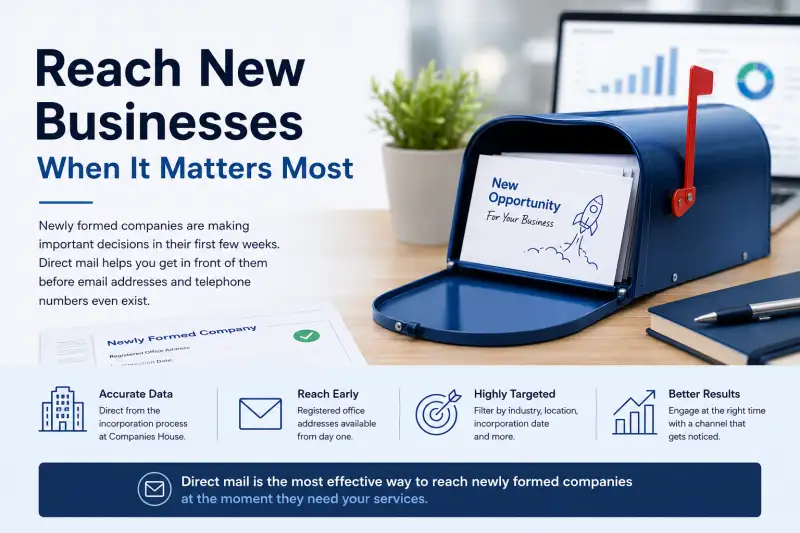
Direct mail benefits from one significant advantage over both email and telephone marketing: every newly incorporated company has a registered office address.
That address forms part of the incorporation process and is published on the Companies House register from day one. This means businesses can begin marketing to newly formed companies almost immediately after incorporation rather than waiting months for additional contact details to appear elsewhere.
A well-designed postal mailing also arrives in a far less crowded environment than an email inbox. Physical mail tends to command more attention and often remains visible for longer. A letter can be read immediately, passed to a colleague or left on a desk as a reminder, whereas an email can disappear from view within minutes.
For businesses looking to engage with newly formed companies at the earliest opportunity, postal mail is often the only reliable channel available.
Better Targeting Through Newly Formed Company Data
The effectiveness of direct mail increases significantly when combined with accurately filtered newly formed company data.
Instead of sending generic marketing to a broad audience, businesses can target companies based on factors such as location, incorporation date, industry sector and company type. This allows marketing messages to be delivered when a company is actively making decisions about suppliers, professional services and business systems. Businesses can also be filtered out if there are multiple companies registered at the same address - either its a mail forwarding service or the director's have multiple companies already and so may not be as interested in your service. As well as targeting on the industry sectors to include, you can instead choose ones to exclude, so accountants would filter out companies in financial services
Timing matters. A company that has been incorporated within the last few days or weeks is often arranging accountancy services, insurance, software, telecommunications, banking and compliance support. Reaching decision-makers during this period can significantly improve response rates.
A Long-Term Marketing Strategy
While many marketers talk about combining direct mail, email and telephone activity from the outset, newly formed company campaigns often work best when they follow the natural availability of the data.
Postal mail is typically the most effective first-contact channel because the registered office address is available immediately following incorporation.
As companies mature, additional information such as business email addresses, websites and telephone numbers often becomes available through public sources. At that stage, marketers can supplement their postal activity with email campaigns and telephone follow-up, creating a multi-channel approach based on increasingly rich business data.
The key advantage is that direct mail allows businesses to engage with new companies from day one, rather than waiting months for alternative contact methods to emerge. For organisations targeting newly formed companies, that early access can make a significant difference to campaign performance and lead generation results. It is a lot easier to sign up a company to use your service if they don't have one currently rather than contacting them 12 months later and having to pry them away from a service they've already chosen to use